
Interview completion pace
 What is interview completion pace?
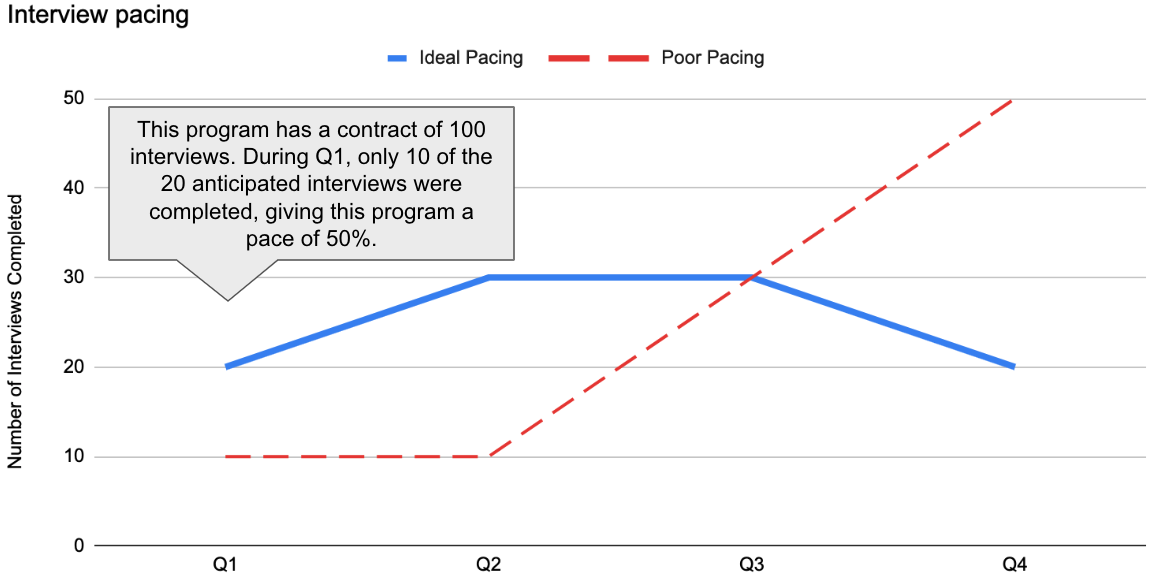
Your win-loss analysis program’s interview completion pace reflects the number of published interviews completed within your contracted timeframe. For instance, to be on pace in a 50-interview program, you should have at least 25 interviews finished by the six-month mark.
Tracking your program's pace ensures that all purchased interviews are completed in a timely manner. Your pace grade on the Clozd Scorecard is based on how your program's progress aligns with the recommended pace set by Clozd.
 How is it graded?

 Why is it important?
Maintaining a steady pace ensures that all the interviews you purchased in your contract are delivered.
Keeping your program on track with Clozd's recommended pace ensures that:
- Interviews are conducted at the necessary rate to meet program deadlines.
- Win-loss feedback is continuous throughout your program's timeline. A steady stream of interviews can be more powerful because it provides a real-time pulse of your business. An even pace also allows you to identify important trends based on topics or competitor mentions. Programs that fail to prioritize pace often experience a rush to complete interviews at the end of the contract period, resulting in a lack of diverse responses.
- The time-to-interview is minimized. Conducting interviews soon after deals close is crucial because it ensures that the feedback is more accurate and valuable.
New win-loss information remains digestible. Digesting the majority of your interviews in the last month of your program can be overwhelming. The most impactful insights come from treating win-loss analysis as a continuous process rather than a last-minute effort.
 How can it be improved?
- Diagnose the barriers to staying on pace. Several factors could contribute to falling behind pace: issues with your contact approval process, fewer deals closing, a suboptimal process for providing contacts (integrating with Salesforce can help with this), low participation rates, or a narrow program scope. This list is not exhaustive, so discuss your pace with your program manager to identify and address the specific issue(s).
- Focus on increasing your participation rate. If you're behind pace, a low participation rate could be the culprit. Click here to learn more about the participation rate section of the Clozd Scorecard.
- Expand your program to include more products or business segments. Broadening your program increases the number of potential interviews, as more products or segments lead to a wider reach. An increase in potential interviews leads to an increase in interviews completed, thus improving your pace.
Note: Some clients may choose to strategically front-load or back-load interviews. If you choose to go this route, we typically recommend to front-load or back-load a portion of your interviews (e.g., 50%) and then distribute the remaining portion more evenly across your program. Think of it like dental care—going to the dentist to get one good cleaning every six months is great, but it’s still best to brush your teeth consistently rather than brush really well once per week.